AI will soon replace GUIs: rebuilding an InDesign leaflet through conversation, not clicks
Will conversational AI interfaces replace graphical desktop applications for document layout design? Traditional GUIs hide layout markup behind visual frames, panels, and drag handles. Replacing mouse-driven layout editing with conversational AI commands turns visual adjustments into explicit code transformations.
Enters natural-language document engineering. Converting a complex InDesign leaflet into a single-source YAML and LaTeX pipeline replaces manual text frame editing with automated build execution.
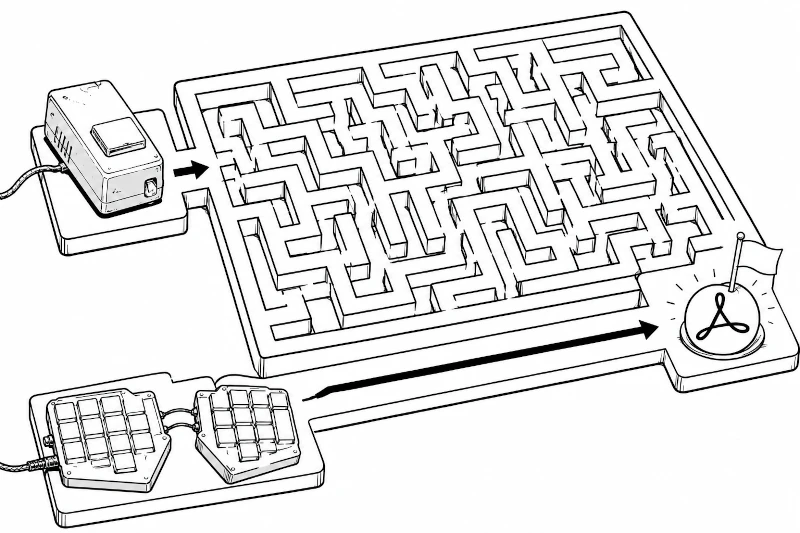 From GUI maze to conversational document engineering: structured data in, PDF out. With a human still checking the result.
InDesign layout limitations
Rebuilding annual print publications in InDesign requires repetitive manual edits across text frames: updating calendar dates, price tables, and contact details frame by frame.
While LaTeX handles multi-page books efficiently, hand-coding bespoke two-page leaflet grids from scratch requires substantial initial setup time. Using LLM coding agents removes the initial barrier to entry for custom LaTeX layout generation.
Conversational layout iteration
Initial LLM layout generations provide basic document structures while requiring iterative refinement:
- Initial scaffolding: Compiling calendar grids and basic column structures automatically.
- Visual review: Identifying spacing discrepancies, font alignment defects, and color profile mismatches.
- Conversational feedback: Issuing targeted correction requests to refine layout parameters.
Iterating through plain-text feedback prompts replaces repetitive mouse clicks with direct code modifications.
Spreadsheet data mapping
Importing structured spreadsheet data directly into YAML files replaces manual transcriptions:
- Schema mapping: Parsing CSV columns into structured YAML key-value pairs.
- Single-source population: Populating calendar grids, event cards, and contact references from single YAML definitions.
- Automated compilation: Rebuilding LaTeX PDFs automatically from updated YAML data.
Updating structured YAML files guarantees consistency across all rendered output surfaces.
Interface model comparison
GUIs require authors to locate specific menu options and edit separate text frames manually. Conversational interfaces translate high-level intent directly into structured source code updates:
Spatial judgment boundaries
Conversational interfaces excel at structural data transformations, while direct visual manipulation remains essential for spatial fine-tuning:
- Visual alignment: Adjusting crop boundaries and image placements by eye.
- Human verification: Reviewing generated PDF outputs to catch subtle spacing defects.
Conversational automation replaces manual data entry while leaving final layout review in human hands. The next step is connecting LLM generation scripts directly to pre-commit linting hooks to flag layout overflow errors automatically.
External sources
Hero image: “Wurlitzer Theatre Organ Console” by Alexander Baxevanis, licensed under CC BY 2.0.Related posts

Follow on LinkedIn for more
Articles on docs-as-code, DITA XML, YAML, and AI-assisted documentation.